How to Write Meeting Minutes That Keep Decisions Clear
Learn how to write meeting minutes that separate discussion from decisions, so neighbors can find what was agreed, what remains open, and what happens next.
The common mistake in meeting minutes is to turn them into a miniature transcript. The result is a crowded record where neighbors who missed the meeting must search for the decision and its next action. Good meeting minutes preserve just enough context to explain the outcome, then make that outcome easy to find.
Imagine a clearly hypothetical neighborhood group deciding what to do with an unused corner of a community garden. Some members favor a bench; others want a pollinator bed. The note-taker starts by separating the options discussed from anything the group actually decides.
Meeting minutes should record decisions, not every sentence
Minutes are a shared memory aid. They help participants recall why a choice was made, let absent members catch up, and give the next meeting a place to begin. They are not usually a verbatim account, and reproducing every comment can hide the information readers need.
For the garden corner, the relevant context might include seating, path access, maintenance, and pollinator planting. A concise summary of those concerns gives later readers a reason for the group’s choice without attaching every remark to a speaker. If a specific proposal, vote, or commitment matters, identify it accurately.
Use plain language to show whether the group discussed an idea, accepted it, rejected it, or left it open. A suggestion is not an agreement, and a task someone might take on is not an assigned responsibility.
Separate discussion, outcome, and follow-up
Organize each agenda item around three distinct kinds of information:
- Discussion: The relevant concerns, options, and reasons raised. If access and upkeep shaped the garden conversation, include those points; if they did not come up, do not imply that they did.
- Outcome: What the group agreed, rejected, postponed, or left unresolved. If members made no final choice, record that status rather than naming a preferred option as approved.
- Follow-up: The task, the responsible person or group, and when progress will be revisited. If nobody accepted the task, mark it unassigned and ask the group to assign it later rather than inventing an owner.
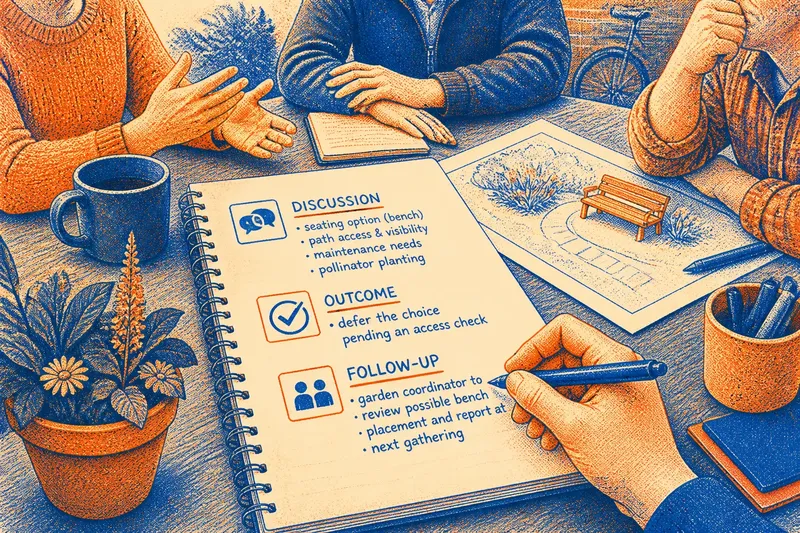
Suppose the group agrees that the garden coordinator will check whether a bench can fit without obstructing the route, then report back at the next gathering. The decision is to defer the choice pending an access check—not to install a bench. That wording keeps the proposal, the current outcome, and the next action from blending together.
Use a compact format people can scan
A plain Google Doc or printed template can work well if the group uses the same structure each time. Include only the details the group needs, and make decisions and follow-ups easy to spot. For each meeting, check these items and choose the next action based on what you find:
- Meeting name, date, place, and note-taker: If any identifying detail is missing, add it before sharing; otherwise, leave the header as recorded.
- Attendance, if the group needs it: If an attendance record is required by the group’s process, include it; otherwise, omit the list rather than collecting unnecessary names.
- Relevant discussion: If a concern explains the outcome, summarize it briefly; if it does not affect the decision or next action, leave it out.
- Decision status: If the group reached an outcome, state it plainly; if the issue remains open, label it unresolved or deferred and do not present an option as settled.
- Follow-up owner: If a person or group accepted the task, name them; if no one did, mark the task unassigned and bring the assignment back to the group.
- Review point: If a date or meeting was set, record it; if not, state how the group will choose one instead of guessing.
- Formal motions or votes: If the group’s rules require them, record them in the required form; if they do not, use a concise outcome statement.
In the invented garden situation, the entry could read: “Corner use: Members discussed seating, path access, maintenance, and pollinator planting. Decision: defer the choice pending an access check. Follow-up: garden coordinator to review possible bench placement and report at the next gathering.” The entry tells readers what was considered, what remains unsettled, and who will act.
A small volunteer circle may need brief notes and action items. A committee with formal responsibilities may need motions, votes, or attendance details. Follow the group’s own rules and consult a qualified professional about legal or regulatory requirements where they apply.
What should meeting minutes say when a decision is not final?
How do you distinguish a proposal from an agreement?
Use words such as “proposed,” “discussed,” and “agreed” to show the status of an idea. In the garden scenario, describe the bench as an option unless the group actually approves it.
What if the group postpones the decision?
Write that the decision was deferred and add the reason if it helps readers understand the delay. Record the next action and review point so the open question stays visible.
Should minutes name the people who spoke?
Usually, summarize relevant points without attaching every comment to an individual. Name someone when the record needs to identify a proposal, assigned task, formal vote, or other specific contribution accurately.
How much discussion belongs in the record?
Include enough context to make the outcome understandable, not every turn of conversation. For the garden group, access and maintenance concerns matter more than reproducing each person’s phrasing.
Review the draft for false certainty
Before sharing the notes, check what the group actually agreed. Did members approve a bench, or agree only to investigate whether one might fit? Did someone accept the follow-up, or was the task left open? These distinctions matter more than polishing every sentence.
In the invented garden situation, the first draft says, “Bench placement approved, pending access check.” The note-taker compares it with the group’s decision and changes it to, “Bench option deferred pending access check.” The corrected wording does not turn an unresolved choice into an instruction.
If the group has a review process, circulate the draft for corrections and record approval as its rules require. Keep edits focused on accuracy and clarity. If members disagree about what was decided, state that disagreement and return the question to the group rather than silently choosing one account.
Make the record easy to find before the next meeting
Store the approved minutes in a shared folder with a clear file name, and link them from the next meeting’s materials. In the hypothetical garden group, members who missed the gathering can then find the deferred choice and access check without relying on someone else’s retelling.
At the next gathering, the coordinator reports that the bench option would obstruct the route, while the pollinator bed remains feasible. The group can resume the conversation with the earlier decision and follow-up in view. The minutes have not made the choice for anyone; they have kept the discussion connected.
Useful meeting minutes leave readers able to tell what was considered, what was settled, and what still needs attention. When you write meeting minutes, a clear status and a named next action are often more useful than a polished account of every comment.