The Open-Door Myth: Why a Welcome Can Still Feel Hard to Enter
Community participation starts with a clear way in. Compare greeters, self-guided starts, and buddies to help newcomers choose a comfortable first move.
The most common mistake in community participation is assuming that an open invitation explains how to join. “Everyone is welcome” may sound generous, but a newcomer at a library meeting room can still wonder whether to find a host, read a sign, or wait to be introduced. The cost is a missed chance to take part, even when the group meant to include them.
A useful welcome makes the first move clear without prescribing how someone must behave. Groups can offer three distinct entry routes: a greeter who answers questions, a self-guided start for people who prefer to orient themselves, or a buddy who learns the activity alongside them. Choosing among these approaches is less about making a grand entrance and more about matching the support to the setting.
Make the first move visible in community participation
“Open door” can describe a policy, a physical entrance, or a friendly intention. None answers the practical questions a first-time visitor may have: Where should I go? Who can I ask? Is there a task for me? Can I take part without committing to future meetings?
Regulars know the room’s informal map. They recognize the person behind the folding table, know which flyers matter, and understand that people may arrive after the advertised start. A newcomer sees none of that as established knowledge. Familiar routines can look like private rules.
The goal is not to remove every uncertainty. It is to offer a clear route into the group and let visitors choose how much help they want. A greeter, a self-guided entry point, and a buddy solve different problems; the best fit depends on whether people need a person, written directions, or hands-on company.
A named greeter answers questions face to face
A greeter is a person assigned to notice arrivals and help them find the next step. This suits a neighborhood association meeting, library volunteer night, or community garden work session with a recognizable entrance. The greeter can point out the coat hooks and sign-in sheet, explain where the activity is happening, and introduce the visitor to someone involved.
The greeter’s advantage is flexibility. Someone who says, “I’m only here to listen,” can be shown a seat without pressure. Someone ready to help can be directed to a suitable task instead of being left to decode the room.
The approach can fail if one busy volunteer is the only source of information. Give the greeter a visible name tag or place a sign by the door that says whom to ask. Keep the role simple: answer immediate questions and offer choices, rather than delivering a memorized speech.
Choose a greeter when arrivals have a clear point of entry and the main uncertainty is whom to approach. If a gathering has several entrances, decide how visitors using each entrance will find help—or choose another route that does not depend on spotting one person.
A self-guided start gives visitors room to orient themselves
A self-guided entry point lets someone begin without asking permission. It could be a “Start here” card on a library table, a map at a community garden gate, or a display showing which supplies are available for a neighborhood cleanup. It should answer one immediate question: what can I do now?
This route works well when people arrive at different times or prefer to look around before speaking. A card might say, “Choose a seat, take a name tag if you like, and join the circle when you’re ready.” At a garden workday, a simple map can point to the watering cans and identify which beds need attention.
Self-guidance becomes a puzzle when people face unlabeled papers, unexplained clipboards, or a QR code with no alternative. Keep the entry point focused: one clear action, a next-step cue, and a nearby person to ask if needed. If joining requires a form or app, say what it is for and offer another way to get the same information.
Choose this route when the activity is flexible and safe to begin from clear directions. If the first task depends on specialized knowledge or a conversation, a greeter or buddy can provide the context a sign cannot.
A participation buddy shares the activity, not just directions
A buddy joins the newcomer in the task rather than merely pointing toward it. At a food pantry, a volunteer might invite a first-time participant to sort donated produce alongside them. At a community art night, a regular might share a table and explain where supplies go while making something together.
This approach makes local routines easier to ask about in context. The newcomer can see how the task works, ask a question when it comes up, and decide whether to continue. Unlike a greeter, a buddy stays with the activity; unlike a self-guided station, a buddy can adjust explanations to the person’s questions and pace.
A buddy needs time and a willingness to let the visitor choose how involved to be. Offer company without assigning a role: “Want to sort these with me, or would you rather read the task card first?” If no buddy is available, point to a self-guided option or name a greeter who can explain the choices.
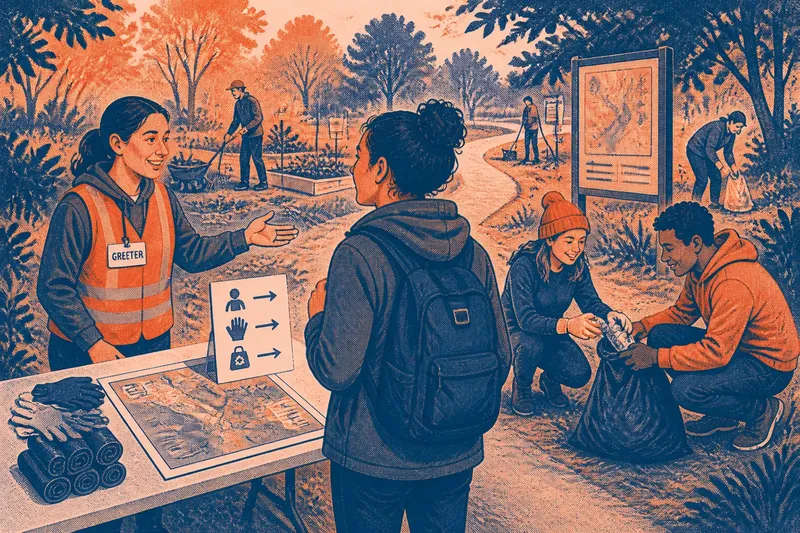
Imagine a first-time visitor arriving at a park cleanup where teams are already working and the sorting rules are unfamiliar. The group has a map, gloves, and bags at a table; a volunteer is also available as a greeter. The greeter explains the two cleanup areas, the visitor chooses the trail edge, and a buddy demonstrates how to separate recyclables from other litter. The visitor can then work alongside the buddy or return to the map and choose another area; the tradeoff is that this route needs a volunteer’s time, while the map alone offers more independence but less explanation.
Choose the entry route by the help the activity requires
Start by identifying what a visitor needs in order to take a first action. Does the person need to know whom to ask, understand a written direction, or learn a task by doing it? A group can offer more than one route, but each should have a clear cue so the visitor is not left to guess.
- Check whether visitors have one obvious entrance. If they do, place a named greeter there; if they do not, use a sign or assign coverage at each entrance.
- Check whether someone can begin safely from written directions. If they can, set out one concise instruction card; if not, arrange a greeter or buddy to explain the first task.
- Check whether the task has unwritten techniques. If it does, offer a buddy who can demonstrate while working; if it does not, a self-guided start may be enough.
- Check whether visitors arrive at different times. If they do, keep a self-guided option available; if arrivals are concentrated and questions are likely, schedule a greeter.
- Check whether the first step requires a form or app. If it does, explain its purpose and provide a non-digital alternative; if it does not, avoid adding registration as an unnecessary gate.
- Check whether the welcome depends on one volunteer. If it does, name a backup person or leave clear written directions; if it does not, keep the route simple and easy to find.
- Check whether visitors can tell what happens next. If they can, keep the cue; if they cannot, add a specific place, person, or action to the entrance sign.
Say you are organizing a library volunteer evening, and the hypothetical starting point is a single entrance, a table of supplies, and tasks that require no special instruction. You expect people to arrive at different times, and a volunteer can answer questions but cannot stay beside everyone. First, keep a named greeter by the entrance so visitors know whom to ask. Next, place a card on the supply table that says which tasks are available and where finished work goes. Then check the setup from the doorway: if a visitor can identify the table and understand a first action, the self-guided route is clear; if not, rewrite the card or add a directional sign. The resulting choice is a greeter plus a self-guided start, not a buddy for every visitor, because the tasks can be explained in writing and arrivals are staggered.
How do you choose a welcome that fits the group?
Does every gathering need a greeter?
No. A greeter helps when people need a person to orient them, while a quiet drop-in space may work better with a clear sign and someone nearby to ask. Choose the simplest route that answers the first practical question.
How can a group welcome someone who prefers to look around first?
Make the self-guided route visible, with a place to sit or a short card explaining what is happening. Offer a person to ask without treating conversation or immediate participation as a requirement.
When is a buddy better than a sign?
A buddy is useful when the task has unwritten routines or is easier to understand by doing it with another person. A sign is a better fit when a clear written cue can explain the first action and the visitor can proceed independently.
How can a group tell whether its entry instructions are clear?
Ask someone unfamiliar with the group to read the entrance sign and describe what they would do next. If they cannot identify a person, place, or first action, revise the cue rather than expecting visitors to infer the routine.
A clear entry route makes community participation easier to begin
Community participation becomes easier to begin when a visitor can see a suitable first move: ask a named person, follow a short instruction, or join someone at the task. Keep the welcome broad, but make the route specific. For a final check, stand where a newcomer would enter and make sure the sign, greeter, or activity buddy is visible before the person has to guess what to do.